Kiss Me Deadly: Evidence of A Style
(Part Two)
5. Depth of Field. The presence of depth in the medium
close two shot of Hammer and Yeager permits a distracting rear
 ground
which
draws attention away or externalizes character emotion.
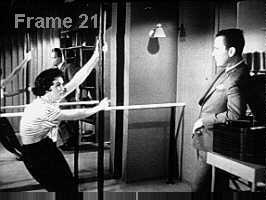
A more "active" use of depth is found in the close two
shot of Christina and the gas station attendant
(7). Because
his profile is present in the left foreground, he is not only
more noticeable than the boxers in the gym but he severely restricts
the amount of the frame in which she can move. As such he externalizes,
even as he exchanges pleasant words with her, the pervasive sense
of constriction which she experiences as a
ground
which
draws attention away or externalizes character emotion.
A more "active" use of depth is found in the close two
shot of Christina and the gas station attendant
(7). Because
his profile is present in the left foreground, he is not only
more noticeable than the boxers in the gym but he severely restricts
the amount of the frame in which she can move. As such he externalizes,
even as he exchanges pleasant words with her, the pervasive sense
of constriction which she experiences as a
 fugitive.
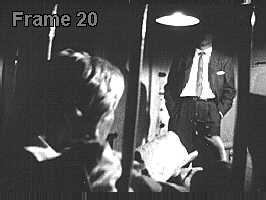
The depth of field in Hammer's first call on Carver situates him
by the door while she reclines in the near ground holding a gun
on him (20). Despite the potential for violence expressed
by the gun, the angle (low) and the deep focus define a large
field in which Hammer can move back and forth. Unlike other objects
or clutter in the foreground, Carver's head and the three bars
in the bed frame work against each other. The center bar separates
her both from Hammer and from her gun, which she holds awkwardly.
The left bar cuts into her head. The right bar completes a rectangle
in which Hammer, posed
 comfortably
with his hands in his pockets,
is alone with the gun but not threatened by it. Lacking constriction,
he can come forward out of the shadows to smile at Carver from
the edge of the bed and establish his dominance over the scene.
comfortably
with his hands in his pockets,
is alone with the gun but not threatened by it. Lacking constriction,
he can come forward out of the shadows to smile at Carver from
the edge of the bed and establish his dominance over the scene.
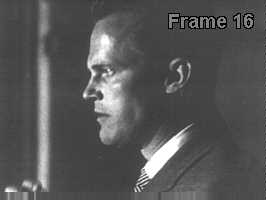
Conversely, the lack of depth caused by a long focal length lens
when Hammer is followed by an unidentified man (16) intensifies
the sense of isolation and real danger implicit in the lonely
street at night. Detached from the rear ground, which is both
out of focus optically and blurred by the panning movement following
him down the sidewalk, Hammer cannot flee into the surrounding
decor but is held in the shallow plane of the lens and must turn
to face his assailant who is photographed in that same plane.
 6.
Opticals. The most unusual optical device in Kiss
Me Deadly is the title sequence. Over a shot of Hammer and
Christina in his car, the main title ("DEADLY/KISS ME"),
cast names, and technical credits all appear and move across the
screen from top to bottom, stacked to be read bottom line first,
like signs painted on the roadway
(4). This inversion of
conventional titles is gimmicky but also appropriate and evocative
of the skewed events which will follow. The final explosion is
accomplised by optical blending of an actual beach house with
a realistic miniature (45).
6.
Opticals. The most unusual optical device in Kiss
Me Deadly is the title sequence. Over a shot of Hammer and
Christina in his car, the main title ("DEADLY/KISS ME"),
cast names, and technical credits all appear and move across the
screen from top to bottom, stacked to be read bottom line first,
like signs painted on the roadway
(4). This inversion of
conventional titles is gimmicky but also appropriate and evocative
of the skewed events which will follow. The final explosion is
accomplised by optical blending of an actual beach house with
a realistic miniature (45).
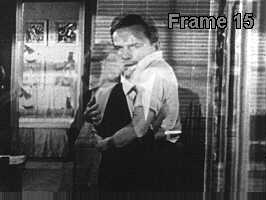
Most of the transitions in Kiss Me Deadly are accomplished
by fades or direct cuts. The dissolve from Hammer looking out
the window of his apartment to him kissing Velda in the center
of the room is unusual for two reasons: it overlays two shots
taken from the same camera position, outside the window (15)
which Hammer's POV reveals is on an upper floor; and it represents
a kind of projection/wish fulfillment in which a character imagines
or anticipates an event and the dissolve reveals
 what
he
was anticipating.
what
he
was anticipating.
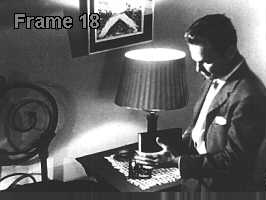
7. Camera Movement. Camera movement, both traveling
and
panning, figures in many of the sequences already discussed, such
as the mirror shot of Hammer and Velda or the attack on Hammer
in the street. Occasionally, the camera will move sideways "under"
an establishing shot to introduce objects into the foreground
and restrict the open area of the frame, for example, the bed
post in Carver's room. At other times, as with the sequence shot
of Hammer's interview with the truck driver, Wallace, the camera
moves slowly inwards, reducing the dimensions of the frame around
the characters and intensifying its "closure" or constriction
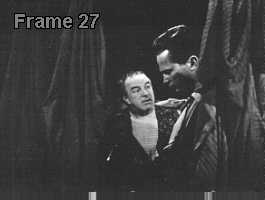
(25) even as the duration of the shot adds tension. An
even more dynamic usage is
 the
boom
down towards Nick as he is
crushed, in which the viewer becomes an active participant in
his murder, by literally being in the position of the car as it
kills him.
the
boom
down towards Nick as he is
crushed, in which the viewer becomes an active participant in
his murder, by literally being in the position of the car as it
kills him.
8. Duration of Shot. Various aspects of the three
sequence-shot
interviews with Wallace, Eddie Yeager, and Carmen Trivago have
already been mentioned. As discussed earlier, the withholding
of a cut in each sequence introduces a tension between the viewer's
expectation of a "normally" occurring cut and its absence,
so that when the withheld cut finally arrives subconscious tension
is released. Even shorter shots, as when Carver shoots Hammer
and he slowly twists and falls (40),
can be slightly "abnormal"
as Aldrich holds the angle for a few extra beats.
In the scene with Trivago, sequence-shot tension is accentuated
both by the literal violence of the events when Hammer
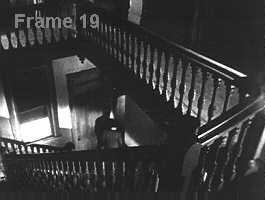 breaks
his record to extort information and the frenetic motion of the
continuous traveling back and forth in his long, shallow room.
Even while the shot is held, the image changes as characters reposition
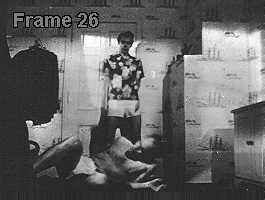
themselves; and clutter such as Trivago's clothes on a line (27)
impinges and recedes in the foreground. In the scene with Yeager,
the sequence shot binds together a number of "individual"
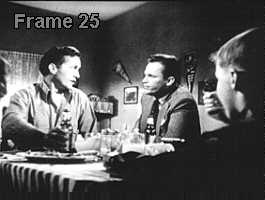
shots (23, 24, 25) linked by traveling and panning and
each affected by its respective framing, lighting, depth, etc.
breaks
his record to extort information and the frenetic motion of the
continuous traveling back and forth in his long, shallow room.
Even while the shot is held, the image changes as characters reposition
themselves; and clutter such as Trivago's clothes on a line (27)
impinges and recedes in the foreground. In the scene with Yeager,
the sequence shot binds together a number of "individual"
shots (23, 24, 25) linked by traveling and panning and
each affected by its respective framing, lighting, depth, etc.
9. Montage. As with duration of shot, montage is primarily
a binding mechanism in Kiss Me Deadly, joining or opposing
other elements of stylistic expression for a compound effect.
A simple example that epitomizes the most basic power of
 montage
as posited by Kuleshov is found in two shots from Hammer's questioning
of the morgue attendant. As the man reaches down to put the key
he found in Christina's body back into a desk, Hammer slams the
drawer shut on his hand (51). The shot
is powerfully violent
in itself, even though neither man's head or shoulders is visible.
Aldrich cuts to a close-up of Hammer grinning
(52), and
in a single shot captures all the sadistic impulses of Spillane's
character. To the silent evocation of abstract meaning which Kuleshov
defined, Aldrich adds the additional dimension of sound, so that
Hammer grins not just at the sight of the morgue attendant's crushed
hand but at his screams and whimpers as well. Later Aldrich combines
an insert (42) and a sound effect
to transform the
"great whatsit" into a living, growling beast.
montage
as posited by Kuleshov is found in two shots from Hammer's questioning
of the morgue attendant. As the man reaches down to put the key
he found in Christina's body back into a desk, Hammer slams the
drawer shut on his hand (51). The shot
is powerfully violent
in itself, even though neither man's head or shoulders is visible.
Aldrich cuts to a close-up of Hammer grinning
(52), and
in a single shot captures all the sadistic impulses of Spillane's
character. To the silent evocation of abstract meaning which Kuleshov
defined, Aldrich adds the additional dimension of sound, so that
Hammer grins not just at the sight of the morgue attendant's crushed
hand but at his screams and whimpers as well. Later Aldrich combines
an insert (42) and a sound effect
to transform the
"great whatsit" into a living, growling beast.
 While
angle
creates the basic meaning in the shot of Carver aimed
upwards over Hammer's shoulder (35), montage intensifies
it when it is intercut with a shot of Hammer aimed down over Carver's
shoulder (36). As in his interview with
the federal men
(12, 13); his discussion with Velda (32);
and the
other instances already described, in this latter shot Hammer
looks away distractedly. This reverse not only reveals his expression
but elaborates the force of Carver's dominance or direction of
Hammer at that point in the film, a force which links the two
separate shots. As an overlay (46) reveals,
the shot of
Pat Murphy over Hammer (39) is composed
identically to
that of Carver over Hammer. It defines a similarly dominant moment
and is complemented by and intercut with another angled shot of
Hammer over Murphy's shoulder.
While
angle
creates the basic meaning in the shot of Carver aimed
upwards over Hammer's shoulder (35), montage intensifies
it when it is intercut with a shot of Hammer aimed down over Carver's
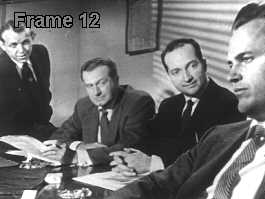
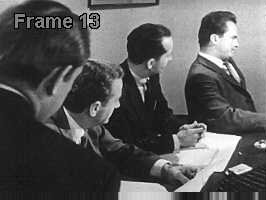
shoulder (36). As in his interview with
the federal men
(12, 13); his discussion with Velda (32);
and the
other instances already described, in this latter shot Hammer
looks away distractedly. This reverse not only reveals his expression
but elaborates the force of Carver's dominance or direction of
Hammer at that point in the film, a force which links the two
separate shots. As an overlay (46) reveals,
the shot of
Pat Murphy over Hammer (39) is composed
identically to
that of Carver over Hammer. It defines a similarly dominant moment
and is complemented by and intercut with another angled shot of
Hammer over Murphy's shoulder.
There are many "normal" reverse shots in Kiss Me
Deadly, such as the cut from Christina facing the oncoming
headlights (1) to behind her
(2), where the context
is highly charged. At other times a shift of angle from high to
low may merely accompany a simple change in camera position as
with Hammer's interrogation (12, 13). Even more severe
shifts in angle occur in the intercuts as Hammer discovers the
"great whatsit" in a locker (37, 38)
and as he
and Carver hurry away from her building (29, 30). These
extreme high/low shifts compel the viewer to reread the shot and
create a visual undercurrent of rupture and instability.
As many of these examples demonstrate, the interaction of montage
and angle, framing and staging, lighting and depth of field create
a multiplicity of stylistic expressions. In the sequence shot
in the gym, eight of the nine elements of style contribute towards
the totality of literal and figurative meaning:
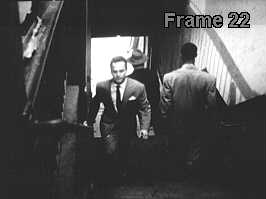
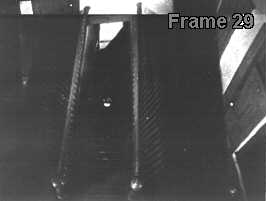
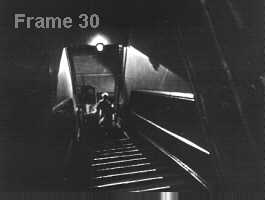
1. Angle: The sequence shot opens with an eye-level
view
of a man punching a bag, follows a figure who crosses the shot
to a stairway, and then tilts down to a high medium shot of Hammer
coming up. It levels off again as Hammer reaches the top of the
stairs and remains at eye-level for the remainder of the shot
(22). The angle shifts at the beginning to disorient the
 viewer,
which in turn subtly connotes, even in broad daylight
and in a large room full of other people, the instability and
menace all around.
viewer,
which in turn subtly connotes, even in broad daylight
and in a large room full of other people, the instability and
menace all around.
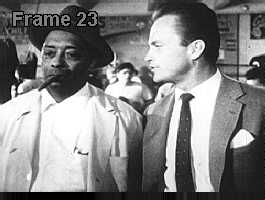
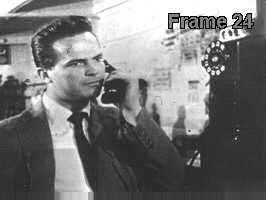
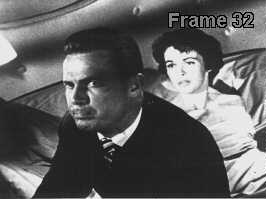
2. Framing: The framing adjusts to follow Hammer in the
beginning, then is balanced in the two shot with Yeager (23).
Hammer is on the left when he places a call later (24),
so that the shadow of the bag can occupy the center of the shot.
Hammer is the narrative center and mostly the visual center. But
other people and objects distract from that and reduce his implicit
control over past, present, and future events.
 3.
Mise-en-scene: Yeager begins the interview with
a smile on his face and his cigar pointed upwards. His expression
sours and the cigar drops down when Hammer mentions Evello's name.
The presence of numerous others in the background raises the noise
level and distracts visually from the principals who are static
in the foreground (23). The subtle chaos again bespeaks
an underlying instability and loss of control.
3.
Mise-en-scene: Yeager begins the interview with
a smile on his face and his cigar pointed upwards. His expression
sours and the cigar drops down when Hammer mentions Evello's name.
The presence of numerous others in the background raises the noise
level and distracts visually from the principals who are static
in the foreground (23). The subtle chaos again bespeaks
an underlying instability and loss of control.
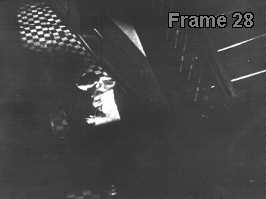
4. Lighting: Full light is used throughout the section
with Yeager, but many dark areas and a bright spot formed by the
street door below accompany the high angle of Hammer on the stairs
(22). The full-lit background combines with mise-en-scene
and depth of field to permit the distraction in the two shot (23).
A separate key light casts the shadow on the wall during Hammer's
phone call.
 5. Depth of Field:
There are three instances: in the high
angle of Hammer (22) allowing him to be recognized while
still near the bottom of the stairs; in the two shot (23)
keeping the rear ground fairly well-defined; and in the phone
conversation picking out sharp shadows on the wall behind.
5. Depth of Field:
There are three instances: in the high
angle of Hammer (22) allowing him to be recognized while
still near the bottom of the stairs; in the two shot (23)
keeping the rear ground fairly well-defined; and in the phone
conversation picking out sharp shadows on the wall behind.
6. Opticals: The fade which concludes the sequence
shot
is followed by a shot of Evello's pool, revealed when a woman
in
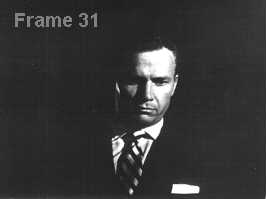 a
black
bathing suit walks away from the front of the camera.
a
black
bathing suit walks away from the front of the camera.
7. Camera Movement: Tilting, panning, and traveling are
used as Hammer moves up the stairs and into the gym. The shot
remains static for some time as he speaks with Yeager, then a
side-traveling follows him to the phone.
8. Duration of Shot: The sequence shot serves to
concentrate
and reinforce the tension and character interaction created
 by
the other elements. This is particularly true given the amount
of movement and re-framing and refocusing in the shot, all of
which add to the difficulty of using one take for the entire sequence.
Each element of movement works with the lack of a cut to enhance
the tension.
by
the other elements. This is particularly true given the amount
of movement and re-framing and refocusing in the shot, all of
which add to the difficulty of using one take for the entire sequence.
Each element of movement works with the lack of a cut to enhance
the tension.
9. Montage: None in this sequence shot, opened and closed
by a fade.
Go to Kiss Me Deadly: Evidence of A
Style, Part Three