Kiss Me Deadly: Evidence of A Style
(Part Three)
Addendum
 Since
this article first appeared twenty years ago, Kiss Me Deadly continues
to be one of the classic period's most discussed films. In the "Postface"
of a new printing of their text, a decade after Paul Schrader called it
"the masterpiece of film noir,"2
Borde and Chaumeton wrote: "1955, the end of an epoch. Film Noir
has fulfilled its role by creating a particular disquiet and providing
a vehicle for social criticism in the United States. Robert Aldrich gives
this happening a fascinating and shadowy conclusion, Kiss Me Deadly.
It is the despairing opposite of the film which, fourteen years earlier,
opened the noir cycle, The Maltese Falcon."3
Since
this article first appeared twenty years ago, Kiss Me Deadly continues
to be one of the classic period's most discussed films. In the "Postface"
of a new printing of their text, a decade after Paul Schrader called it
"the masterpiece of film noir,"2
Borde and Chaumeton wrote: "1955, the end of an epoch. Film Noir
has fulfilled its role by creating a particular disquiet and providing
a vehicle for social criticism in the United States. Robert Aldrich gives
this happening a fascinating and shadowy conclusion, Kiss Me Deadly.
It is the despairing opposite of the film which, fourteen years earlier,
opened the noir cycle, The Maltese Falcon."3
One of the most discussed aspects of Kiss Me Deadly is its ending,
which the filmmakers themselves referred to as "Let's go 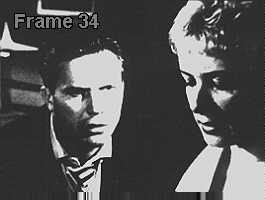 fission."4
Borde and Chaumeton were a bit more effusive when they spoke of "savage
lyricism" and "nuclear apocalypse." Before going further,
it should be noted that unfortunately both the 16mm prints and the video
version of Kiss Me Deadly are missing scenes no. 305 and 307.5
As I mentioned in the third edition of Film Noir: An Encyclopedic Reference
to the American Style, some commentators most notably Jack Shadoian
in Dreams and Dead Ends and J.P. Telotte in Voices in the Dark,
have questioned whether Mike and Velda stumble into the surf. Shadoian
even suggests that since many of Raymond Durgnat's recollections are wrong,
so is his version of the ending.6
Telotte does not know "whether such accounts indicate the existence
of an alternate ending for the film or simply represent the kind of creative
recollection-prodded by wish fulfillment-that often marks film commentary."7
One might wonder why any commentator would "wish" for Velda and
Hammer to survive. Certainly audience expectations might be for that survival;
but in terms of narrative irony, it would seem most apt for Hammer to witness
the apocalypse which he and others have wrought [see Aldrich's remarks
below].
fission."4
Borde and Chaumeton were a bit more effusive when they spoke of "savage
lyricism" and "nuclear apocalypse." Before going further,
it should be noted that unfortunately both the 16mm prints and the video
version of Kiss Me Deadly are missing scenes no. 305 and 307.5
As I mentioned in the third edition of Film Noir: An Encyclopedic Reference
to the American Style, some commentators most notably Jack Shadoian
in Dreams and Dead Ends and J.P. Telotte in Voices in the Dark,
have questioned whether Mike and Velda stumble into the surf. Shadoian
even suggests that since many of Raymond Durgnat's recollections are wrong,
so is his version of the ending.6
Telotte does not know "whether such accounts indicate the existence
of an alternate ending for the film or simply represent the kind of creative
recollection-prodded by wish fulfillment-that often marks film commentary."7
One might wonder why any commentator would "wish" for Velda and
Hammer to survive. Certainly audience expectations might be for that survival;
but in terms of narrative irony, it would seem most apt for Hammer to witness
the apocalypse which he and others have wrought [see Aldrich's remarks
below].
Even critics who accept the existence of this ending have further compounded
the problem by such assertions as "the studio added a final shot still
there in some prints showing Hammer and Velda standing amid the waves."8
Here Robin Wood suggests that Aldrich did not want these two cuts in the
finished picture. In a more recent book Edward Gallafent asserts that a
"gesture to the benign couple remains in some prints."9
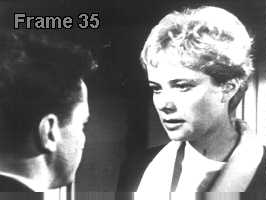
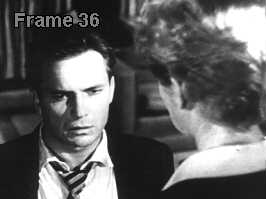
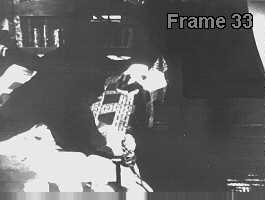
These shots should be in all the prints, and Aldrich never regarded
them as any sort of gesture. While they had never seen a complete print,
Edward Arnold and Eugene Miller asked Aldrich about the ending, and he
replied, "I have never seen a print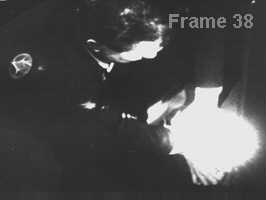
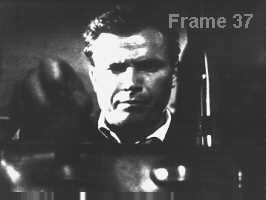 without, repeat, without Hammer and Velda stumbling in the surf. That's
the way it was shot, that's the way it was released; the idea being that
Mike was left alive long enough to see what havoc he had caused, though
certainly he and Velda were both seriously contaminated."10
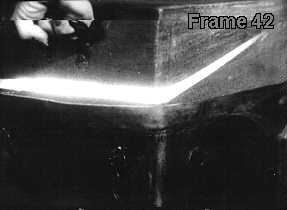
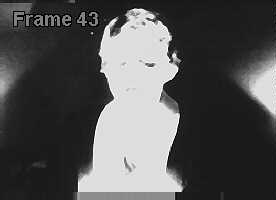
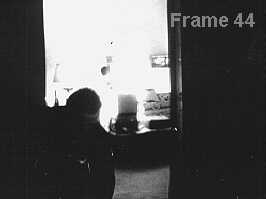
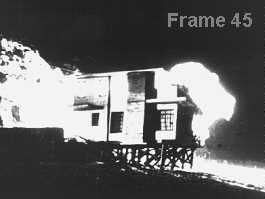
Viewers of the laser disc of Kiss Me Deadly can catch a glimpse
in the theatrical trailer included at the end of the disc of one shot of
Mike and Velda in the surf as the house explodes [or watch the GIF
animation on the home page].
without, repeat, without Hammer and Velda stumbling in the surf. That's
the way it was shot, that's the way it was released; the idea being that
Mike was left alive long enough to see what havoc he had caused, though
certainly he and Velda were both seriously contaminated."10
Viewers of the laser disc of Kiss Me Deadly can catch a glimpse
in the theatrical trailer included at the end of the disc of one shot of
Mike and Velda in the surf as the house explodes [or watch the GIF
animation on the home page].
In comparing Kiss Me Deadly with Fritz Lang's The Big Heat,
Robin Wood remarks that "the sledgehammer sensibility that 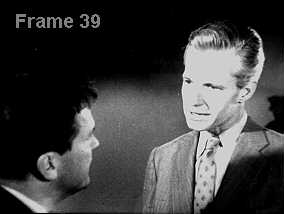 is
both the strength and weakness of Kiss Me Deadly prohibits any nuance."11
Even Andrew Sarris' early assessment suggests an uncontrolled atmosphere:
"Aldrich's direction of his players generally creates a subtle frenzy
on the screen, and his visual style suggests an unstable world full of
awkward angles and harsh transitions."12
Wood's critique may reflect the same ambivalence towards Aldrich's authorial
consciousness and/or political correctness as Raymond Borde had when he
questioned Aldrich's beliefs in 1956: "We've been discouraged so often
that we are wary of American liberals. Like most left of center Americans
Aldrich can evidently deceive us from one day to the next."13
Borde's concern about being deceived did not diminish his enthusiasm for
Kiss Me Deadly as expressed in Panorama du Film Noir Américain.
In 1968 Sarris also believed that Kiss Me Deadly was a "most
perplexing and revealing work...a testament to Aldrich's anarchic spirit."14
is
both the strength and weakness of Kiss Me Deadly prohibits any nuance."11
Even Andrew Sarris' early assessment suggests an uncontrolled atmosphere:
"Aldrich's direction of his players generally creates a subtle frenzy
on the screen, and his visual style suggests an unstable world full of
awkward angles and harsh transitions."12
Wood's critique may reflect the same ambivalence towards Aldrich's authorial
consciousness and/or political correctness as Raymond Borde had when he
questioned Aldrich's beliefs in 1956: "We've been discouraged so often
that we are wary of American liberals. Like most left of center Americans
Aldrich can evidently deceive us from one day to the next."13
Borde's concern about being deceived did not diminish his enthusiasm for
Kiss Me Deadly as expressed in Panorama du Film Noir Américain.
In 1968 Sarris also believed that Kiss Me Deadly was a "most
perplexing and revealing work...a testament to Aldrich's anarchic spirit."14
Whether Aldrich or A.I. Bezzerides were leftists, anarchists, or any
other type of "ist" outside of the context of the films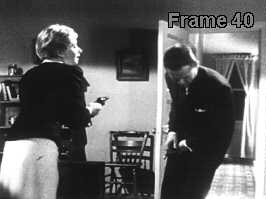 themselves seems less of a concern for more recent commentators. Perhaps
this is because Kiss Me Deadly typifies those rare films which transcend
critical modalities. Borde and Chaumeton, Schrader, Durgnat, Sarris, Wood,
and scores of other critical writers all agree on the merits of the film.
Structuralist, formalist, feminist, auteurist, and Marxist critics alike
have all found something to admire in it. A quarter of century apart, Borde
and Wood both remark on how Aldrich transformed Spillane's solipsistic
and reactionary novel into something remarkable. Whether or not Kiss
Me Deadly does anticipate the freeform narratives of the New Wave or,
it could be argued, the self-conscious stylistic de-constructions of later
Godard, it is undeniably multi-faceted and complex in attitude.
themselves seems less of a concern for more recent commentators. Perhaps
this is because Kiss Me Deadly typifies those rare films which transcend
critical modalities. Borde and Chaumeton, Schrader, Durgnat, Sarris, Wood,
and scores of other critical writers all agree on the merits of the film.
Structuralist, formalist, feminist, auteurist, and Marxist critics alike
have all found something to admire in it. A quarter of century apart, Borde
and Wood both remark on how Aldrich transformed Spillane's solipsistic
and reactionary novel into something remarkable. Whether or not Kiss
Me Deadly does anticipate the freeform narratives of the New Wave or,
it could be argued, the self-conscious stylistic de-constructions of later
Godard, it is undeniably multi-faceted and complex in attitude.
For many observers the mixture of film noir, McCarthyism, and
"va-va-voom" has, to use Sarris' celebrated analogy from The
American Cinema, caused a confusion between the forest and the trees.
Borde sensed it when he wrote that "on the extreme right, certain
imbeciles have identified this thriller as the quest for the Grail."15
Shadouin may not have been aware of Borde's assertion but was reacting
to my comment [see p. 212 above] when he wrote that "Hammer is the
inheritor of a superfluous culture and a superfluous role, a modern, ironic
Galahad whose quest leads him to a fire-breathing atomic box."16
Telotte takes up this issue and ultimately concludes that "like Perceval,
Mike fails as a quester." 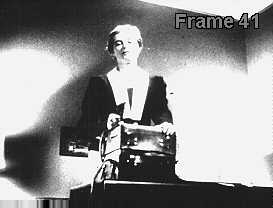
 As
I suggested twenty years ago, Kiss Me Deadly obviously is
a quest for a noir grail. Whether or not Hammer "fails"
as a quester is less important than the quest itself. From his name to
his survival of the assault to his ability to overcome Evello's thugs,
Hammer clearly has, as Shadouin notes, mythic qualities; but in myth some
protagonists succeed and others fail. Aside from the question of "Subject/Object
split and First Person Usage," which was a sub-head in the Film
Comment article, my other context in originally writing that Hammer
is not another Galahad but is a quester was Aldrich's World for
Ransom.17
In that film Julian March, the principal antagonist, actually says to the
white-suited hero Mike Callahan: "You shouldn't play Galahad. You're
way out of character." Ignorant of more distant past behaviors to
which March may be referring, the viewer has only seen Calahan shelter
a woman who betrayed his love and risk his life for the good of society.
The irony in Marsh's comment is that for Calahan "playing Galahad"
is not "way out of character." Superficially, that same irony
does not apply to
As
I suggested twenty years ago, Kiss Me Deadly obviously is
a quest for a noir grail. Whether or not Hammer "fails"
as a quester is less important than the quest itself. From his name to
his survival of the assault to his ability to overcome Evello's thugs,
Hammer clearly has, as Shadouin notes, mythic qualities; but in myth some
protagonists succeed and others fail. Aside from the question of "Subject/Object
split and First Person Usage," which was a sub-head in the Film
Comment article, my other context in originally writing that Hammer
is not another Galahad but is a quester was Aldrich's World for
Ransom.17
In that film Julian March, the principal antagonist, actually says to the
white-suited hero Mike Callahan: "You shouldn't play Galahad. You're
way out of character." Ignorant of more distant past behaviors to
which March may be referring, the viewer has only seen Calahan shelter
a woman who betrayed his love and risk his life for the good of society.
The irony in Marsh's comment is that for Calahan "playing Galahad"
is not "way out of character." Superficially, that same irony
does not apply to  Hammer
and his "what's in it for me?" attitude in Kiss Me, Deadly.
What is actually in play in Kiss Me Deadly is not a standard
archetype but a part of process that social historian Mike Davis describes
as "that great anti-myth usually known as noir."18
Hammer
and his "what's in it for me?" attitude in Kiss Me, Deadly.
What is actually in play in Kiss Me Deadly is not a standard
archetype but a part of process that social historian Mike Davis describes
as "that great anti-myth usually known as noir."18
 Hammer is indeed
an "anti-Galahad" in search of his "great whatsit,"
a perfect colloquialism to stand in for and parody the fabled concept of
a Grail. Wood calls Christina's perception of Hammer's narcissism at the
beginning of Kiss Me Deadly "abrupt and rhetorical." But
in an anti-mythic structure, a classic invocation of the epic hero, like
Virgil's "Of arms and the man I sing" must be transformed into
an antiheroic equivalent, something like: "You're the kind of person
that has only one true love: you." This tension between myth and anti-myth,
between hero and antihero, is one key to Kiss Me Deadly and the
root of the complexity which Wood finds lacking. Hammer is a radically
different character than many who preceded him in film noir and
in Aldrich's work as well. For Aldrich, who often spoke of turning concepts
on their heads, Hammer is the consummate anti-idealist.
Hammer is indeed
an "anti-Galahad" in search of his "great whatsit,"
a perfect colloquialism to stand in for and parody the fabled concept of
a Grail. Wood calls Christina's perception of Hammer's narcissism at the
beginning of Kiss Me Deadly "abrupt and rhetorical." But
in an anti-mythic structure, a classic invocation of the epic hero, like
Virgil's "Of arms and the man I sing" must be transformed into
an antiheroic equivalent, something like: "You're the kind of person
that has only one true love: you." This tension between myth and anti-myth,
between hero and antihero, is one key to Kiss Me Deadly and the
root of the complexity which Wood finds lacking. Hammer is a radically
different character than many who preceded him in film noir and
in Aldrich's work as well. For Aldrich, who often spoke of turning concepts
on their heads, Hammer is the consummate anti-idealist.
Most recent commentaries beginning with Telotte have refocused on narrative
issues. A simple example is a recent essay by R. Barton Palmer which consists
mostly of plot summary (but, at least, he gets the ending right). Palmer's
other comments, 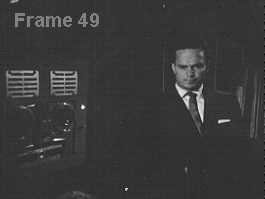 such
as calling Hammer a "knight" because "he proves vulnerable
to the desperation of ladies in distress" or saying "real locations...do
not seem nightmarish,"19
are puzzling. Palmer does call Aldrich "perhaps the most political
of noir directors."20
This runs slightly counter to Gallafent's assertions about Aldrich's intentions.
Gallafent explores the history of Spillane's prose and the evolution of
Aldrich's assessment of his work through interviews; but he never cites
Aldrich's most direct statement on the film's "sex and violence."21
Gallafent characterizes "the release of massive physical violence"22
in the scene where Hammer beats up a pursuer as an expression of Hammer's
sexual frustration. In fact, complete with obscure allusions to the work
of Douglas Sirk, Gallefent tries to make the entire narrative revolve around
sexual frustration. One hesitates to think
such
as calling Hammer a "knight" because "he proves vulnerable
to the desperation of ladies in distress" or saying "real locations...do
not seem nightmarish,"19
are puzzling. Palmer does call Aldrich "perhaps the most political
of noir directors."20
This runs slightly counter to Gallafent's assertions about Aldrich's intentions.
Gallafent explores the history of Spillane's prose and the evolution of
Aldrich's assessment of his work through interviews; but he never cites
Aldrich's most direct statement on the film's "sex and violence."21
Gallafent characterizes "the release of massive physical violence"22
in the scene where Hammer beats up a pursuer as an expression of Hammer's
sexual frustration. In fact, complete with obscure allusions to the work
of Douglas Sirk, Gallefent tries to make the entire narrative revolve around
sexual frustration. One hesitates to think 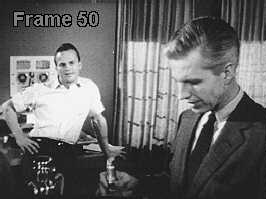 what
unprecedented orgasmic connotations Gallafent might derive from the final
explosion.
what
unprecedented orgasmic connotations Gallafent might derive from the final
explosion.
Still other commentators have taken analysis of the components of sex
and violence much further than Gallafent. For one critic Hammer's violent
beating of that same pursuer is an example of his repressed homosexuality
in a film full of masculinized women and phallic symbols that is ultimately
"homophobic as well as misogynistic."23
Carol Flinn searches not for a great whatsit but for "feminine sexuality
which displays itself so lavishly across this and other examples of film
noir."24 In
considering "aural signifiers" Flinn raises several points. For
instance, her mention of Christina's labored breaths at the film's beginning
being "closer than they ought to be" and creating "a break
in cinematic verisimilitude"25
suggests one aural equivalent to the unusual visual elements in Kiss
Me Deadly. Other subtle effects, such as dog barking outside Christina's
house that seems to foreshadow Soberin's reference to "Cerberus barking
with all his heads," understandably go unnoticed; but many obviously
unusual sound elements, like Mist's loud snoring or Evello's literal expiration
or even the growl of the box 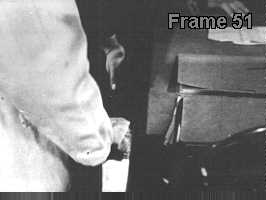 itself,
are inexplicably overlooked amid discussions of dialogue and music.
itself,
are inexplicably overlooked amid discussions of dialogue and music.
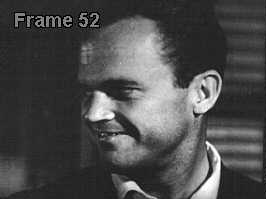 Despite
these wide-ranging critical excursions, one never gets the sense that the
depths of Kiss Me Deadly have been fully probed. Certainly Kiss
Me Deadly ranks with the most important examples of film noir
by any director. It has the menace of Night and the City, the grim
determinism of Out of the Past, the cynicism of Double Indemnity,
the reckless energy of Gun Crazy, and the visual flourish of Touch
of Evil. Its focus on the underlying sense of nuclear peril that haunted
the end of the noir period could not have been more apt. If Kiss
Me Deadly also reflects such contemporary issues as McCarthyism and
moral decline, those, too, are part of the fabric of film noir.
Despite
these wide-ranging critical excursions, one never gets the sense that the
depths of Kiss Me Deadly have been fully probed. Certainly Kiss
Me Deadly ranks with the most important examples of film noir
by any director. It has the menace of Night and the City, the grim
determinism of Out of the Past, the cynicism of Double Indemnity,
the reckless energy of Gun Crazy, and the visual flourish of Touch
of Evil. Its focus on the underlying sense of nuclear peril that haunted
the end of the noir period could not have been more apt. If Kiss
Me Deadly also reflects such contemporary issues as McCarthyism and
moral decline, those, too, are part of the fabric of film noir.
As it happens, Aldrich's early career as assistant director and director
coincides with the beginning and end of the classic period of film noir;
and he would revisit many of the noir cycle's themes. sometimes
accompanied by A.I. Bezzerides, in later films. But as a symbol of what
film noir epitomized or of the powerful, malevolent forces lurking
in the Aldrich/Bezzerides vision of the modern world, nothing would ever
loom larger than a mushroom cloud over Malibu.
>CLICK HERE TO RETURN TO THE FILM
NOIR READER PAGE
>CLICK HERE TO RETURN TO THE BIBLIOGRAPHY PAGE
Copyright © 1975 by the Film Society of Lincoln
Center (Film Comment). Reproduced by permission. New material for this Film Noir Reader version, Copyright
© 1996 by Alain Silver.